Use the Resource Library by clicking on any of the boxes below.
Criminalization of HIV and sex work in Western and Central Africa
This paper aims to explore the intersection of HIV criminalization and sex work to better understand how HIV criminalization affects sex workers, but also how the different forms of HIV criminalization and sex work reinforce each other and exacerbate violence and discrimination against sex workers living with HIV in the region.
This project is a continuation of the work initiated by And Soppeku, an organization of sex workers in Senegal, which published an advocacy document on the issue in 2023, with the support of HIV Justice Worldwide.
Submission to the Review of Part 4 of the Criminal Law (Sexual Offences) Act 2017
HIV Ireland's submission as part of the Review of Part 4 of the Criminal Law (Sexual Offences) Act 2017. The submission urges the Review Committee to fully decriminalise sex work in order to respect, protect and fulfil the right to the highest attainable standard of health of sex workers; to take into account the negative impact that current legislative provisions are having on sexual health and to consider the detrimental effects that current legislative provisions are having on access to justice for sex workers and to ensure that their voices are feature prominently throughout the review.
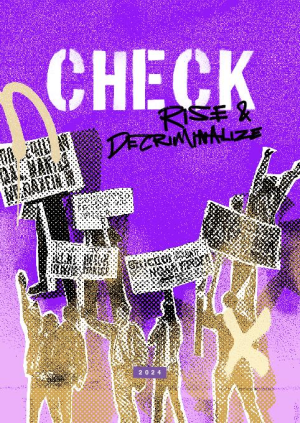
Check – Rise and Decriminalise
In this issue of Check, you will find information about drug laws in the region, the spectrum of drug policy, what are alternatives to punishment for drug crimes and what is not, interviews with leaders of the Rise & Decriminalize movement, and other stories about drug policy in the region. The Rise & Decriminalize Movement unites 5 regional networks – ECOM, EHRA, ENPUD, EWNA & SWAN – and is tailored to commonly advocate for the rights of vulnerable populations, including LGBTQI+, people who use drugs, women living with HIV, and sex workers.
Intersecting issues, identities, and barriers in access to health care, HIV services & sexual and reproductive health and rights among key populations in Central and Eastern Europe & Central Asia
This briefing paper explores the impact of intersecting identities—such as LGBT, people who use drugs (PWUD), sex workers (SW), and people living with HIV (PLHIV)—on health access, agency, and social justice in the context of structural inequalities and stigma. Using the framework of intersectionality, it examines how overlapping identities shape lived experiences of discrimination, influencing mental and physical health outcomes and access to healthcare services. The paper is based on cross-regional consultations conducted across 14 countries in Central and Eastern Europe and Central Asia (CEECA), including surveys and focus group discussions with 103 individuals with multiple intersecting identities.
Sex Work and Migration in CEECA
This briefing paper presents the findings of a mapping exercise undertaken by the Sex Workers’ Advocacy Network (SWAN) in early 2021. It explores the situation and needs of migrant sex workers in the Central, Eastern Europe, and Central Asia region (CEECA). It outlines the key trends identified by members of the Network and makes initial recommendations to address gaps in services and advocacy.
- Alternative links
- СекС-работа и Миграция в цвеца
Smart Sex Worker’s Guide to Decriminalisation
This Smart Guide provides an overview of existing sex work legal models and details the processes that have been used to develop legislative models that respect and protect sex workers’ human and labour rights. It aims to provide sex workers’ rights organisations with ideas and strategies that they can adapt to their own legal framework and context, to use in their advocacy and campaigning in their own countries. It also highlights the learning and best practices from both New Zealand and Australia, as well as the potential challenges and pitfalls involved in pursuing a decriminalisation advocacy strategy.
The Impact of Criminalisation on Sex Workers’ Vulnerability to HIV and Violence
This policy brief examines the impact of laws that criminalise sex work, informed by NSWP members’ submissions to an e-consultation. It examines the impact of criminalisation at three distinct phases: the surveillance and policing of sex workers prior to arrest; arrest and formal involvement of the criminal justice system; and release and return to the community. The paper covers various areas of law and law enforcement practices that disproportionately impact sex workers, including immigration laws, policing of public spaces, anti-LGBTQ laws, HIV criminalisation and religious codes.
Tracing the “Infectious Criminal”: A Genealogy of HIV Criminalization and Infectious Injustice in Finland
This article examines the junction of state healthcare and punishment through HIV criminalization. By problematizing the application of criminal law to HIV in Finland, the study locates a genealogy of the “infectious criminal” – a figure at the cusp of these two forms of state power. The article traces how this figure, evoked in official debates from the early 20th century onwards, justified punitive measures to control marginalized people, from poor merchants to prisoners-of-war, sex workers, vagrants, and later, migrants. Drawing on parliamentary archives, the article asks how punishment and existing social injustices are narrated, maintained, and connected. Revealing a continuum of punishment and healthcare, HIV criminalization – especially within a nation deemed exceptionally non-punitive and welfare-oriented – is a crucial point from which to examine the connections of social injustice and criminal justice.
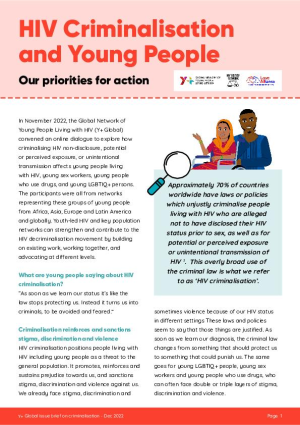
HIV Criminalisation and Young People
In November 2022, the Global Network of Young People Living with HIV (Y+ Global) convened an online dialogue to explore how criminalising HIV non-disclosure, potential or perceived exposure, or unintentional transmission affects young people living with HIV, young sex workers, young people who use drugs, and young LGBTIQ+ persons. The participants were all from networks representing these groups of young people from Africa, Asia, Europe and Latin America and globally. Youth-led HIV and key population networks can strengthen and contribute to the HIV decriminalisation movement by building on existing work, working together, and advocating at different levels.
OptTEST case study 4: Removing sex work regulations in Greece
In April 2012, the Greek police carried out a massive operation in downtown Athens, arresting drug users and sex workers, forcing them to undergo HIV testing and charging them with prostitution. This case study explores the response from human rights and HIV groups both in Greece and internationally and the following campaign to repeal the provision.
PRACTICAL GUIDE FOR PARALEGALS: Supporting People Living with HIV Affected by HIV Criminalization in the EECA Region
The purpose of this guide is to raise the legal awareness of activists from the community of people living with HIV who provide paralegal assistance to people affected by the criminalisation of HIV. This guide is also recommended for use by activists from key populations - people who use drugs, sex workers, and representatives of the LGBT community. This manual reflects the experience of the HIV-positive community members, as well as their partners and associates from across Eastern Europe and Central Asia (EECA), in providing direct assistance to HIV-positive people affected by discriminatory HIV-specific laws and the decriminalisation of HIV.
UNAIDS calls on Greece to protect sex workers and their clients through comprehensive and voluntary HIV programmes
UNAIDS expresses its concerns about the Greek Government’s treatment of alleged sex workers and also asylum seekers who may have an infectious disease.
- Alternative links
- French / Français, Russian / РУССКИЙ , Spanish / Español,
HIV Disclosure to Sexual Partners: Questions & Answers for Newcomers
Includes information about the criminal law in Canada, public health, and specific implications for newcomers, including permanent residents, students, temporary workers, visitors, refugees, and people without immigration status.
- Alternative links
- Chinese / 中文, French /Français, Punjabi / ਪੰਜਾਬੀ ਦੇ, Spanish / Español

Criminal laws on sex work and HIV transmission: Mapping the laws, considering the consequences
Presents a public health law mapping of U.S. states that mandate HIV testing and criminalize HIV positive sex workers. Shows HIV transmission and exposure laws interact with sex work laws to compound criminal penalties for people charged with prostitution related crimes. Argues that decriminalization of sex work and HIV transmission and exposure is integral to effectively address the HIV epidemic.
Counselling anomie: Clashing governmentalities of HIV criminalisation and prevention
Found that HIV criminalisation is rendering disclosure counselling difficult and potentially compromising trust between healthcare workers and patients. Counsellors’ understanding of the up-to-date science of HIV transmission risk also conflicts with the need to inform clients to disclose before any kind of sex to avoid prosecution – even when condoms are used or they have a low viral load. The study concludes that it is not only difficult for counsellors to determine when to discuss legal obligations during the counselling process, but exactly how to discuss them without undermining therapeutic relationships.
HIV Criminalisation and Sex Work in Australia
Reports that following the high profile prosecution of an HIV positive sex worker (no transmission), sex workers became fearful of HIV testing for HIV. In the four-week period following the court case, attendance at the sex worker outreach medical service dropped from an average of 40 per night to three.